...

How to Minimise Capital Gains Tax in Australia

• April 22, 2026

Featured Image

Capital gains tax (CGT) is one of the most significant tax obligations Australians face when building wealth; but with the right planning, there are legitimate, proven ways to reduce what you owe. Whether you’re selling an investment property, offloading shares, or restructuring a business, understanding your CGT position before you act can save you thousands.

At W Advisory, we work with individuals, investors, and business owners every day to navigate the complexities of the Australian tax system. In this guide, we break down the most effective strategies to minimise capital gains tax; in plain language, with real-world context.

What Is Capital Gains Tax in Australia?

Capital gains tax isn’t a separate tax in Australia; it’s part of your income tax. When you sell a capital asset (like property, shares, or a business) for more than you paid for it, the profit is called a capital gain, and it’s added to your assessable income for that financial year.

The Australian Taxation Office (ATO) includes your net capital gain in your taxable income, which means it’s taxed at your marginal rate. Depending on your income, that could be anywhere from 19% to 45%, plus the Medicare levy.

The good news? The tax law includes a number of legitimate concessions, timing strategies, and structural options that can significantly reduce your CGT liability — or in some cases, eliminate it altogether.

1. Use the 12-Month CGT Discount

This is one of the most powerful CGT strategies available to Australian residents, and it’s completely above board.

If you hold a capital asset for more than 12 months before selling, individuals and trusts are entitled to a 50% CGT discount. That means only half of your capital gain is included in your assessable income.

For example, if you sell an investment property and make a $200,000 capital gain after holding it for over 12 months, only $100,000 is added to your taxable income. That’s a substantial saving; particularly if you’re in a higher tax bracket.

Our advice: Before selling any asset, always check whether waiting until the 12-month threshold is met makes financial sense. In many cases, a short delay can result in a significant tax saving.

2. Offset Capital Gains With Capital Losses

Capital losses can be used to reduce your capital gains in the same income year; or carried forward to offset gains in future years. There’s no time limit on carrying forward capital losses, which makes them a valuable planning tool.

If you hold investments that have dropped in value, you may consider selling them in the same year you realise a capital gain, effectively reducing your net gain.

This is sometimes called tax-loss harvesting, and while it needs to be approached carefully (wash-sale rules and the ATO’s Part IVA general anti-avoidance provisions are relevant here), it’s a legitimate strategy when done for genuine commercial reasons.

Our advice: We regularly review our clients’ portfolios near the end of the financial year to identify opportunities to crystallise losses and offset gains strategically.

3. Time Your Disposal Carefully

When you sell an asset matters; sometimes just as much as how you sell it.

If you expect your income to be significantly lower in an upcoming financial year (due to retirement, career change, parental leave, or business restructure), it may be worth deferring the sale until that lower-income year. A smaller taxable income means a lower marginal rate applies to your capital gain.

Similarly, if you’re approaching the end of a financial year, consider whether settling a sale in the next financial year makes sense. This defers the tax liability by 12 months, giving you more time to plan.

Our advice: We always look at timing in the context of a client’s broader income picture — not just the asset being sold.

4. Maximise Your Small Business CGT Concessions

For eligible small business owners, the small business CGT concessions are arguably the most generous tax breaks in the Australian system. If you qualify, you may be able to reduce a capital gain by 50%, defer it, or even exclude it entirely.

There are four main concessions:

  • 15-year exemption — If you’ve owned a business asset for 15 or more years and you’re 55 or older (or permanently incapacitated), you may be able to completely disregard the capital gain.
  • 50% active asset reduction — Reduce your capital gain by 50% if the asset was an active asset used in your business.
  • Retirement exemption — Exclude up to $500,000 (lifetime limit) of a capital gain, with amounts contributed to superannuation in some circumstances.
  • Rollover concession — Defer a capital gain by rolling it into a replacement asset.

Eligibility is complex; you need to satisfy the basic conditions (turnover under $10 million, or net assets under $6 million) and meet asset-specific tests. But for business owners selling a practice, a commercial property, or a business interest, these concessions can be genuinely transformative.

Our advice: If you’re selling a business or business asset, speak with us before you do anything else. The structure of the sale, and the entities involved, can significantly affect whether you qualify.


5. Contribute to Super

If you’re selling a business asset and eligible for the retirement exemption, contributing to superannuation can be a tax-effective way to manage the gain. Super contributions can effectively shelter proceeds from further taxation, particularly for clients approaching retirement age.

More broadly, structuring wealth-building activities through superannuation; where assets are taxed at a concessional 15% rate, and 0% in pension phase; is a long-term CGT minimisation strategy in its own right.

Our advice: Super is a powerful tool, but contribution caps and eligibility rules apply. We always look at super as part of a holistic tax plan, not a standalone lever.

6. Consider the Main Residence Exemption

Your family home is generally exempt from CGT under the main residence exemption; one of the most significant tax-free assets most Australians hold.

However, the rules become more complex when:

  • You rent out part of your home
  • You use part of your home for business purposes
  • You’ve moved in and out over the years (partial exemption rules apply)
  • You lived overseas for a period
  • You inherit a property

Getting the main residence exemption wrong is a costly mistake. We see it regularly, particularly with clients who’ve rented out former homes, used Airbnb, or inherited property without understanding the CGT implications.

Our advice: If your situation is anything other than straightforward, you’ve always lived there, never rented it, and never used it for business — get advice before you sell.

7. Choose the Right Ownership Structure

The entity that owns an asset can have a significant impact on the CGT outcome when you sell.

  • Individuals access the 50% CGT discount after 12 months.
  • Trusts can access the 50% discount and distribute gains to beneficiaries in lower tax brackets.
  • Companies do not access the 50% CGT discount — gains are taxed at the corporate rate (25% for base rate entities, 30% otherwise), which may or may not be advantageous depending on your situation.
  • Superannuation funds pay 10% on discounted gains in accumulation phase (and nothing in pension phase).

Getting the structure right before you acquire an asset is far more powerful than trying to fix it after the fact. Restructuring mid-ownership can itself trigger CGT.

Our advice: We work with clients at the acquisition stage to ensure assets are held in the most tax-effective structure for their goals — not just today, but over the long term.

8. Keep Thorough Records

This one isn’t a strategy per se, but it underpins all of them. The ATO requires you to keep records of all capital gains events; purchase price, improvement costs, selling costs, dates of acquisition and disposal, and any elections you’ve made.

Good records mean you can:

  • Accurately calculate your cost base (which reduces your gain)
  • Include all eligible costs (legal fees, stamp duty, renovations)
  • Substantiate your claims if the ATO asks questions

Many clients underestimate their cost base simply because they don’t have records going back far enough. That’s money left on the table.

Plan Before You Act

CGT planning isn’t something you do after you’ve sold an asset; it’s something you do well before. The strategies that make the biggest difference (timing, structure, concessions, super) all require lead time.

At W Advisory, we take a proactive approach to tax planning for our clients. We don’t just prepare your tax return; we work with you throughout the year to identify opportunities, manage your obligations, and structure your affairs so you keep more of what you earn.

If you’re thinking about selling a property, shares, a business, or any other capital asset, we’d encourage you to talk to us first. Even a short conversation can uncover significant savings.

Disclaimer –The information in this guide is general in nature and does not constitute personal financial or taxation advice. Your individual circumstances will affect how these strategies apply to you. Please speak with one of our advisers before taking any action.

Other Blogs

Digital bookkeeping in Australia

Digital Bookkeeping in Australia: Why Manual Records Are Dying

The way Australian businesses manage their finances is rapidly evolving. Traditional paper-based bookkeeping—once the backbone of financial record-keeping—is now being replaced by faster, smarter, and more efficient digital systems. From small businesses in Sydney to growing enterprises across NSW and beyond, digital bookkeeping in Australia is becoming the new standard. With compliance requirements tightening and …

Does a Sole Trader Need an Accountant

Does a Sole Trader Need an Accountant? 5 Signs It’s Time to Hire

As a sole trader in 2026, you’re not just running a business—you’re managing everything from client work to admin, compliance, and finances. It’s common for many business owners to ask: does a sole trader need an accountant, or can I manage everything myself? At W Advisory, we work with sole traders across Sydney who start …

tax compliance Australia

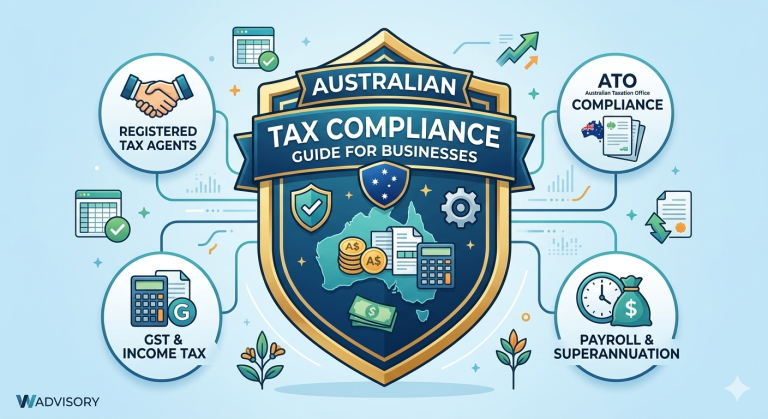
Tax Compliance for Businesses in Australia

Operating a business in Australia involves more than delivering products or services. Businesses must also meet a range of tax compliance obligations set by the Australian Taxation Office (ATO). From reporting income to paying taxes on time, maintaining proper tax compliance is essential to avoid penalties, maintain financial transparency, and ensure the long-term stability of …

Featured Image
We will help business owners and
professionals overcome the burden of
poor tax advice, and inefficient structures

by delivering tailored strategies
that are compliant, minimise tax
and are structured to create
generational wealth.

Seraphinite AcceleratorOptimized by Seraphinite Accelerator
Turns on site high speed to be attractive for people and search engines.